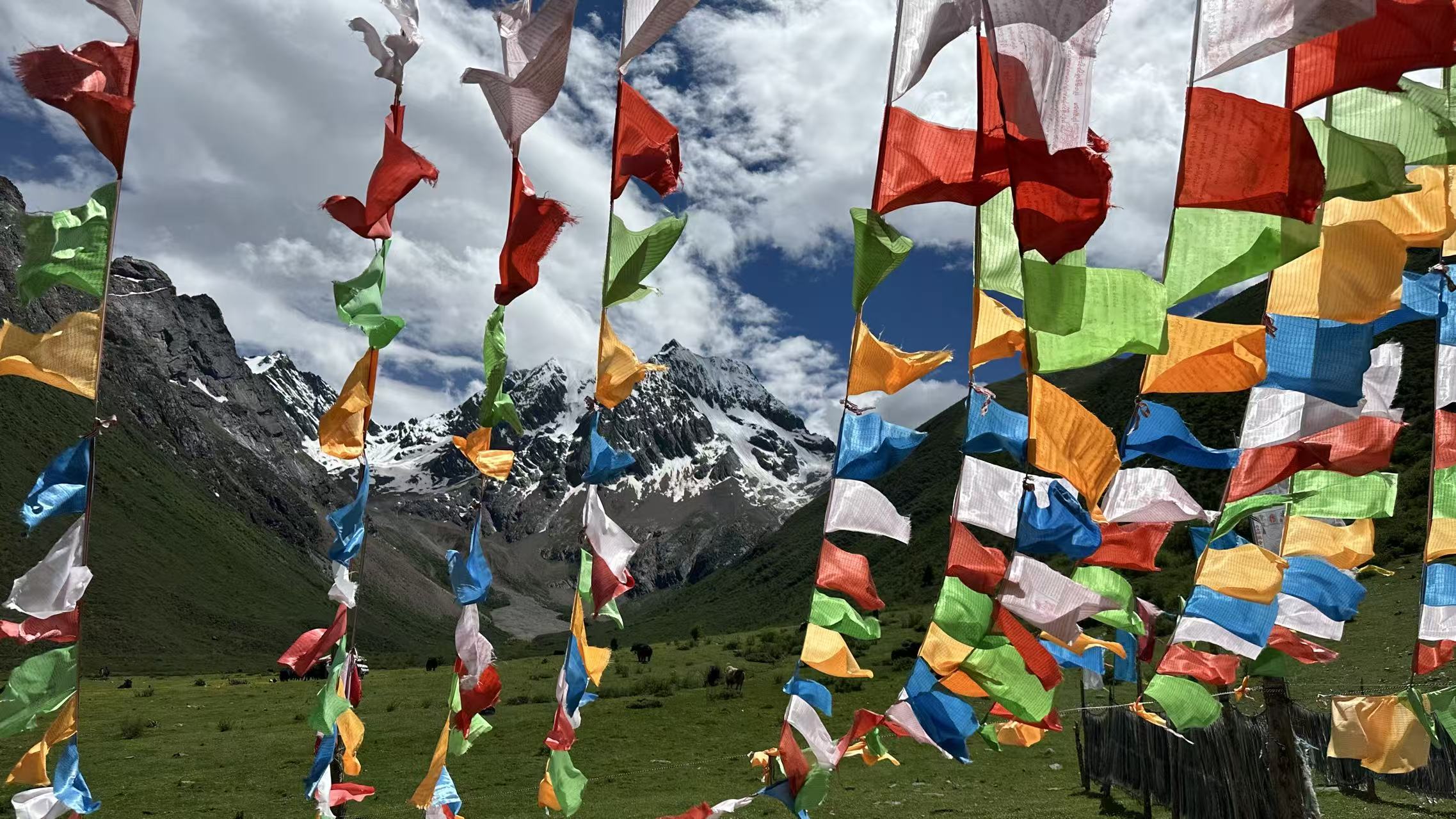
Two · Local people
Our way of life and our philosophy of survival
"Perhaps this is how the world is: most people gather in cities,
and a small number are scattered across certain wild places, looking after stretches of the earth that the rest have not yet learned to value."
— From Fire Meteors Over Manigango (火流星飞过马尼干戈)
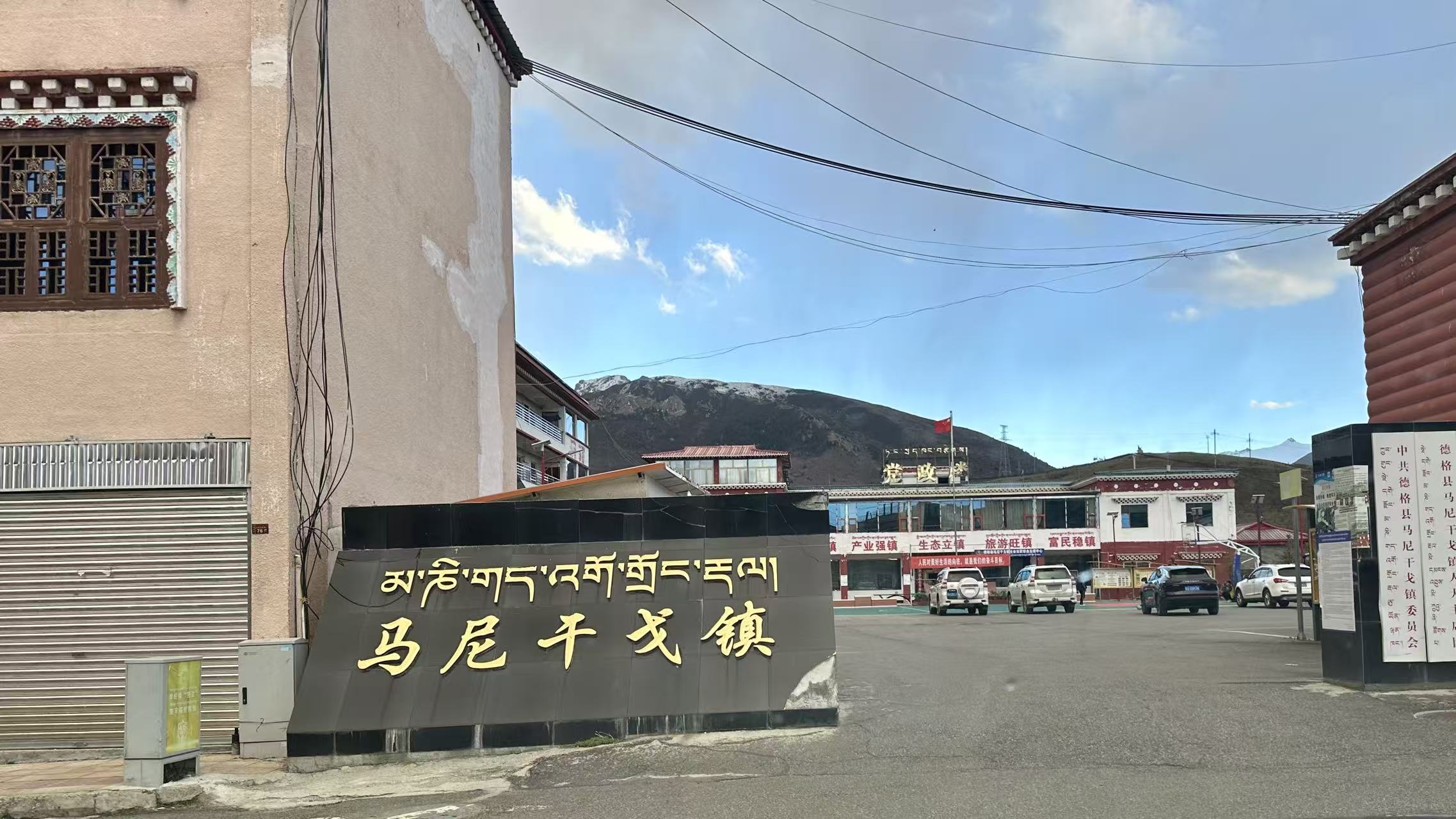
Within this 656.26-square-kilometer town live roughly six thousand people, eighty percent of them herders dispersed across the pastures. Because the land is wide and the people are few, the world here is large enough to hold human grief and joy alike — and to transform them in time.
Town days
Those who live clustered in the town mostly occupy family-built houses of their own: a small multi-story building, a courtyard, pines and willows, a carpet of grass, uncountable wildflowers.
Some make a living running small businesses. Some have fixed jobs — teachers, civil servants, government staff. Others pick up seasonal work, the so-called "freelancers," or a half-herding, half-working life: taking turns with the family to tend the yaks while also taking on small jobs within the region as they come.
By spring and summer, everyone is up in the mountains again digging medicinal herbs — mainly caterpillar fungus (cordyceps) and fritillary bulbs, sometimes also rhodiola and others. By long-standing custom, each village digs only on its own land.
The rush lasts through July, then the digging tapers off and people settle into summer: setting up tarps or large parasols in the courtyard, drinking tea, eating snacks, and chatting in the temperate sun with the family. When they want to be closer to the hills, they take a big tent and full cooking gear, find a place — sometimes one with no signal at all — by a meadow, a lakeside, or a mountain hollow, and stay for an afternoon, a day, or a few days.
Life on the range
The herders' life is simpler. They tend yaks and sheep, moving with the seasons to wherever water and grass meet — alpine meadows, river valleys, mountain hollows. Herding families are usually a young or middle-aged couple with all the children; they spend the whole summer deep in the mountains together.
Summer is when the grass is rich and the yaks are at peak milk. A typical family with a hundred yaks might have twenty to thirty milking cows. At the July–August peak, each cow gives about a kilogram of milk per day. Over two days, that's roughly forty kilograms of fresh yak milk — though in practice about thirty percent is set aside for the calves, so the amount that goes into processing is closer to thirty kilograms.
In the era before centrifuges, herders worked with tools that have been passed down for a thousand years: wooden butter churns, long-handled wooden pestles, cloth or bamboo strainers, clay or copper pots. The whole process depended on strength, experience, and the rhythms of nature. Slow and laborious as it was, it held a deep knowledge of the land and a near-perfect use of every resource. Every drop of butter, every piece of milk curd, was a small crystallizing of labor and wisdom — and a basic pillar of life on the plateau.
Today, every family has a centrifuge. Mechanical separation pulls the fat out quickly and efficiently; once the fat firms a little, it is shaped into butter. The skimmed milk is then simmered down into dried curd. From thirty kilograms of milk, a family can get about four to five kilograms of butter (selling at around 50 yuan per jin) and three to four kilograms of dried curd (at 10 to 15 yuan per jin). For most herding families, this is one of the year's most important sources of income.
Summer pasture work begins at five in the morning — milking the cows, turning them out, making butter and curd, then bringing them back at dusk, vaccinating, treating the sick, and looking for any that have strayed.
In winter, some herders drive the yaks and sheep up to higher, more sheltered mountain pastures; others keep them closer to the family home. The movement still follows the seasons. Winter brings no butter-and-curd work, but herding becomes harder: the herder has to follow the animals across frozen rivers, frozen ground, snow-covered slopes — wherever the yaks' hooves can go, the people must go too. If an animal is lost, no matter how raw and glacial the country looks, the herder goes to find it. Injuries and entrapments in snow and ice are common in winter; both people and animals carry a doubled risk in this season.
A yak lives about twelve years from birth to natural death. The herders here live off their yaks and sheep, but they are not in the cattle business — they slaughter only the two or three they need to feed their own family for the year, plus a few more to cover basic needs. Strictly speaking, the yak is not a commodity for the herder; they are family and companions. Herders remember the face and the temperament of every yak in their herd, and many give each one a name.
Calendar and religious life
People here live by the Tibetan calendar, which has similarities to the Han Chinese lunar calendar. Within this "snow-land time," a high-plateau system keyed to phenology, the markers of time are mostly set by agricultural work and religious events. There are no "holidays" in the secular sense: aside from the Tibetan New Year spent with family, every other celebration centers on a religious date and is held as a large gathering.
The horse-racing festival falls in July and August.
The cordyceps season is over, and families have a fresh round of income. The grass is at its richest, the meadows in full bloom, the weather gentle. Families set up tents at a chosen ground with food enough for several days of celebration. There are traditional song-and-dance performances — the young people and the children going round in turns — and rituals of the men on horseback scattering lungta (龙达 / 撒龙达) and honoring the mountain deities. Alongside, there are horse races on the grassland and impromptu contests: riding at full gallop in Tibetan dress with muzzle-loading guns, foot races, tug-of-war.
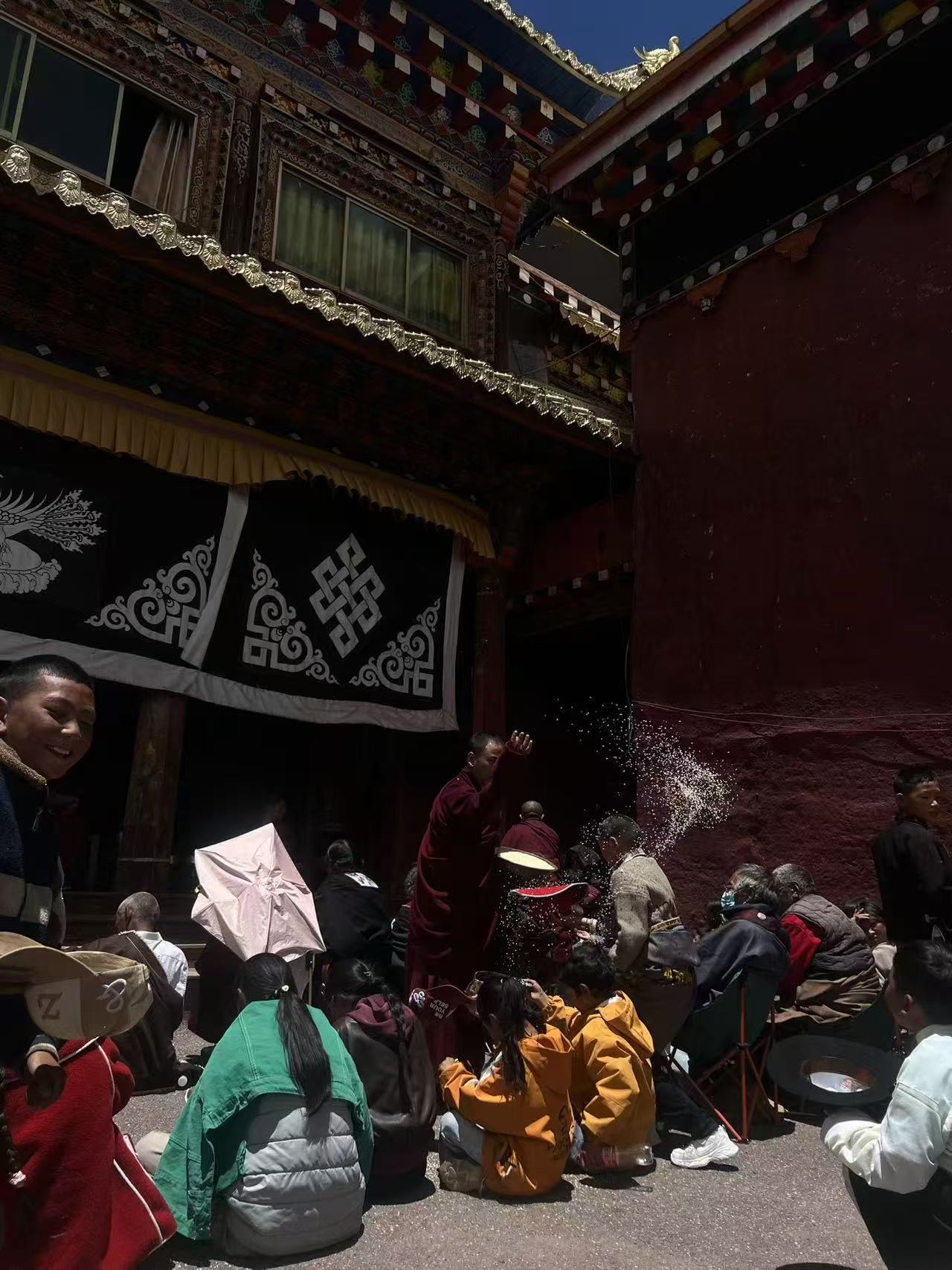
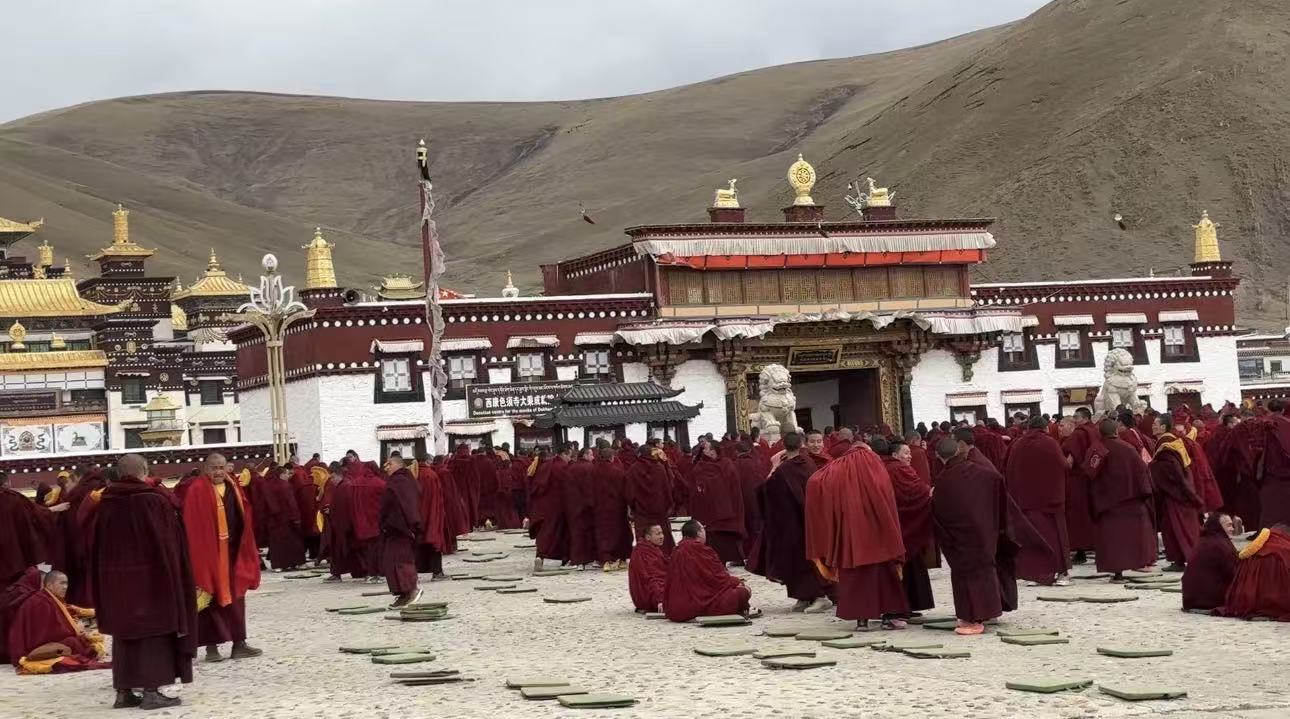
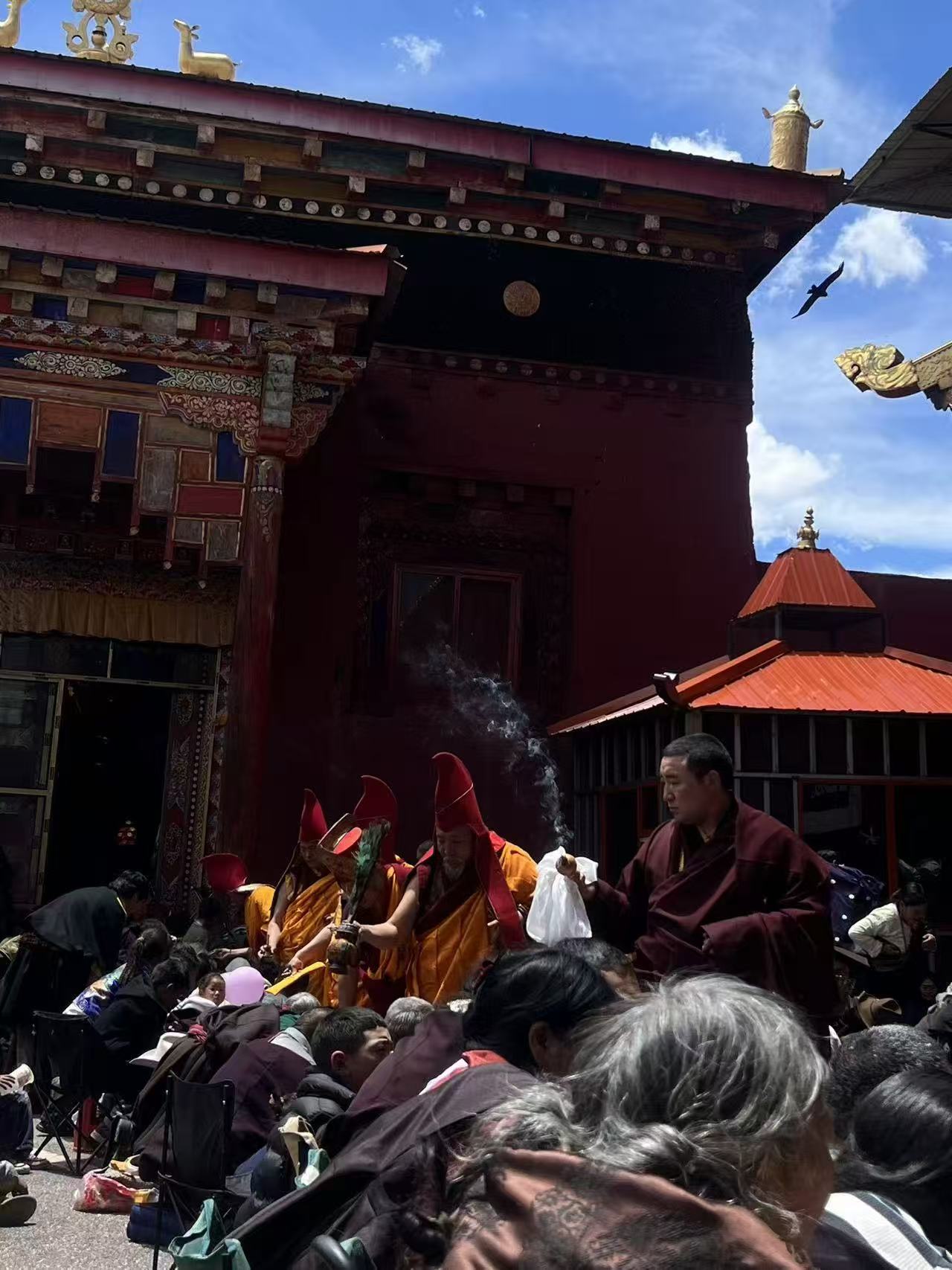
A second kind of festival is the dharma assembly held at the monastery.
Most Tibetan Buddhist assemblies commemorate major events in the life of Shakyamuni Buddha, or pass down a particular highest-tantra teaching. According to records, the Buddha prophesied that in the dark age, Kalachakra would appear in many forms. By holding grand assemblies, the faithful pray for peace and good fortune, for the dispelling of misfortune, and for the accumulation of merit and the purification of negative karma. These gatherings are not only religious ceremonies and material exchange; they are also the great reunion of local Tibetans across the wide land, bound by a single faith. Laypeople come dressed in their finest traditional Tibetan attire, wearing heirloom jewels.
A philosophy of life and spiritual core
Before modern schooling was widespread, the Sakya Verses (《萨迦格言》), composed by Sakya Pandita, head of the Sakya school of Tibetan Buddhism, had long since moved beyond any single sect and become a treasury of maxims recited across the Tibetan world. The verses emphasize benevolence, altruism, integrity, honesty, and diligence; they counsel putting others before oneself, seeking out the learned, and befriending the upright. Together with the local religious life and the proverbs passed from mouth to mouth, this little book forms the cultural and moral bedrock of the people — and it is what allows them to keep a quiet, equanimous, contented spirit even in the face of daily hardship.
Competition is not encouraged here. From ancient times, a non-competitive sharing order has held. Forests and herbs are held in common, and regardless of whether one was born into a village rich in resources or a poor one, no one infringes on another for the sake of the harvest. Between people there is a steady warmth and goodwill: a wave to a stranger, an invitation into the home for tea, food, or help. This kindness has been cycling for over a thousand years. To this day, travelers still flag down rides along the road, and drivers who cannot stop have their own hand signal to say so. Pilgrims on the long road to Lhasa still count on staying in Tibetan homes along the way, and they are welcomed and sheltered with unfailing hospitality.
People here hold all life in reverence, believing every creature has a spirit and that any animal in this life may have been a close relative in a previous one — so they do not kill. Mosquito larvae in the water, earthworms in the soil, are released. In diet, they prefer to live on the meat of large animals like yak and sheep rather than take the life of a small one. The people here have a transcendent view of time and existence. They do not believe humans are the masters of the earth, but that they live on the land alongside all other living things, each passing through its own span of life, and that the best end is "to disappear without a trace, cleanly and quietly."
Continue browsing
The other two angles
One · Wild environment
Wildness and nature
Snow peaks, glaciers, alpine pastures, deep valleys — more unnamed corners than named attractions.
See detailThree · Four seasons
Spring · summer · autumn · winter — the turning of the year
Spring digging cordyceps, summer flower seas, autumn hills ablaze, winter harsh but alive — locals move with the pastoral year.
See detail