One · Wild environment
Wildness and nature
Mountains you'll never tire of, in any season
The named ones —
- Chola Shan (雀儿山), 6,168 m — Sichuan's fourth-highest peak and one of the most renowned 6,000-meter summits in the international high-altitude mountaineering world.
- Zhuqing Snow Mountain (竹庆雪山), 5,849 m, with its subsidiary peak Norbu Gya, at 5,750 m.
- And the many glaciers born from these mountains.
The unnamed ones —
Sit by any window, cross any grassland, walk any stretch of road or any mountain trail: the silhouettes, the profiles, the colors that shift with the seasons — they will reveal themselves, eventually, to whoever comes to them.
Rivers and lakes
The Yu Qu (玉曲) river — one of the headwaters of the Jinsha system, also called Cuo Qu (措曲) — runs through the whole region. Countless small streams rise from every snow mountain, flow through the valleys, feed the land, and eventually reach the sea.
The lakes lie scattered through the mountains like hidden treasures:
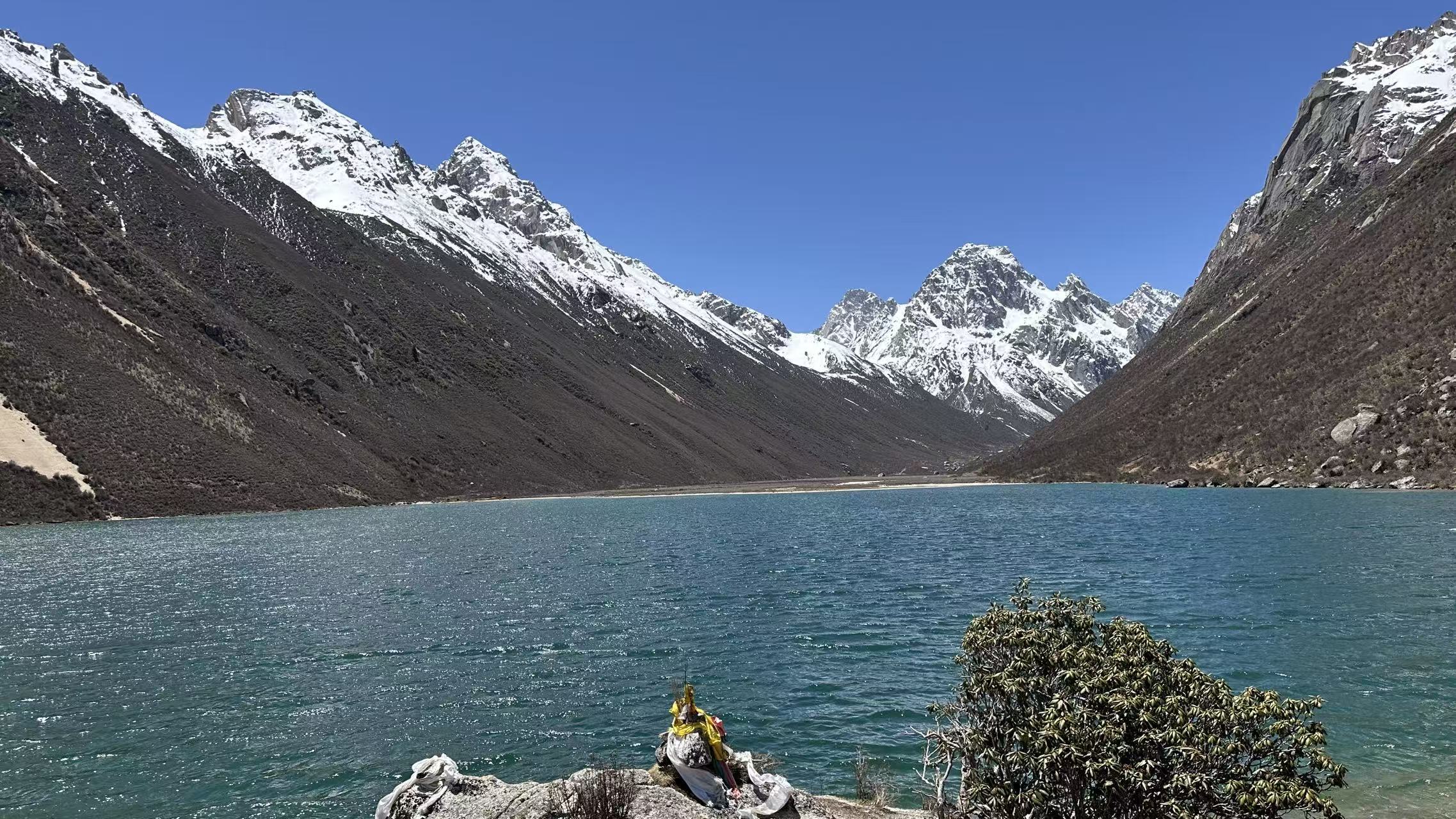
- Yulong La-co (玉龙拉错), at the foot of Chola Shan, 4,040 m — China's largest glacial moraine-dammed lake.
- Ren Co (仁措), 4,200 m, a lake beside Yulong La-co, surrounded by snow mountains — the dwelling place of the mountain gods, the locals say.
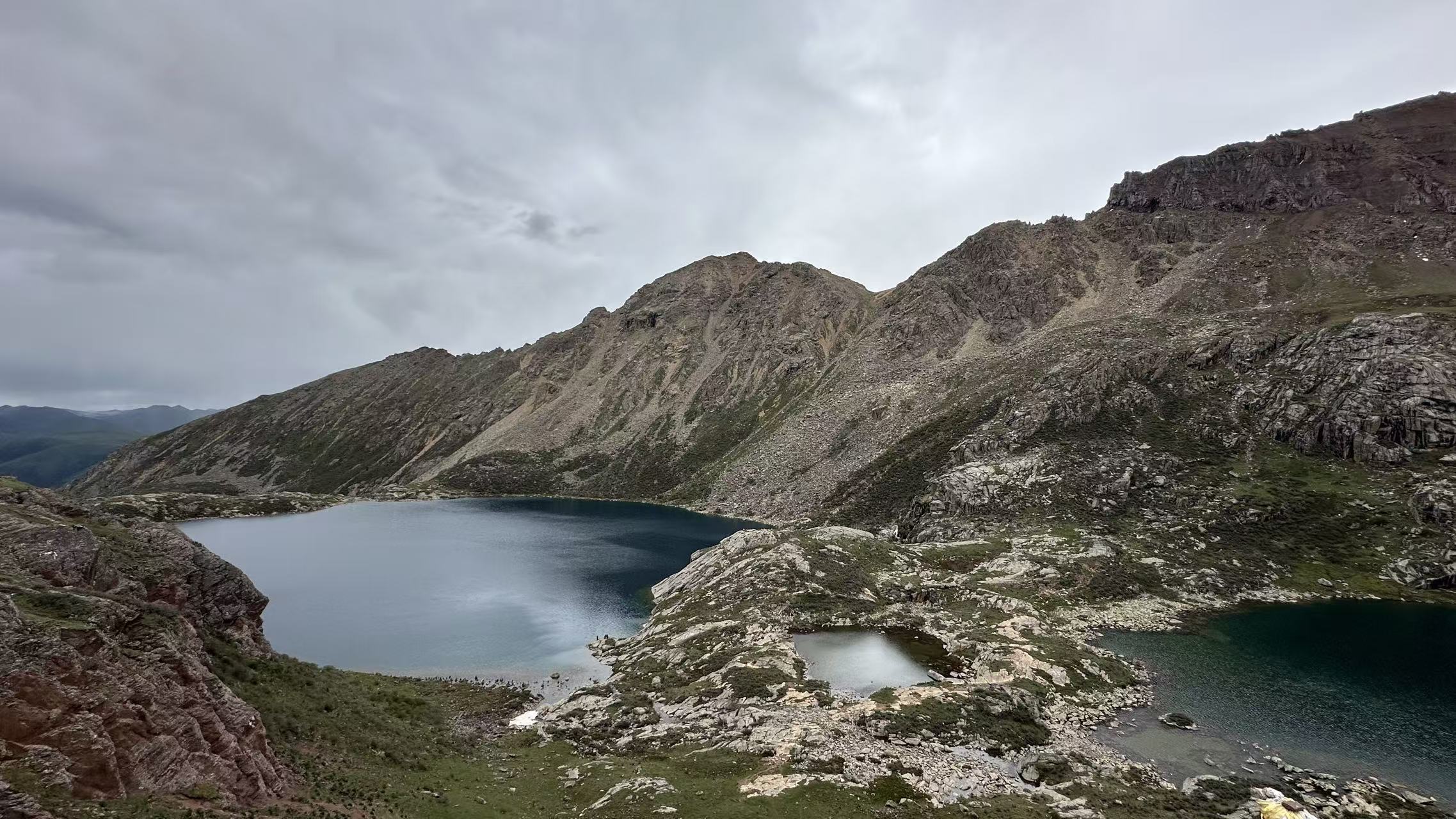
- Cuotong Cui-hu (错通翠湖), three linked lakes at the top of a mountain ridge, 4,500 m — to reach them you drive nearly 20 km of winding gravel road through primeval forest, alpine meadow, and pastures with herders, their yaks and horses, and the original-style huts of the high pastures.
- Muri Co (木日错), 4,600 m, a high-altitude lake set in a plateau wetland. Every early summer, villagers gather at its shore to honor the mountain deity, raise great tents, hold picnics (shuaba-zi 耍坝子), and race horses.
And too many smaller, unnamed lakes to count, scattered through the mountains.
Wild hot springs — a generosity of the earth
Beneath this land lie acidic rocks with radioactive content. When this combines with the gravitational forces of the earth's movements, heat begins to build. This heat — together with the energy of redox reactions deep within the earth — warms the groundwater. When the hot springs rise through cracks in the rock to the surface, we have what we call a hot spring. It was a natural gift to people living in this cold high place, especially in earlier times when water was hard to come by.
Walk into Gegong village, follow the village road, and head deeper into the wilderness along the river — wild springs bubble up from underground. The local herders only take a few of the springs, surrounding them lightly with stone and cement to keep enough water for bathing; the rest they leave to the animals and to the earth.
Or take Xueke village: a pasture crossed by a river, lush in summer and magnificent under deep winter snow. The hot springs are right by the river. The herders dig a small pit below a spring and ring it with stones. So natural, so wild — being there feels like returning to the womb of the earth: warm, clear, soft against the body, with the eye falling on a vastness that opens out, without boundary, in front of you and inside you.
Cuo'a township's "terma" (hidden-treasure) hot spring is a half-wild spring guarded by a single family. From the start, the entrance fee has been ten yuan per person — and ten years on, it is still ten yuan. The spring lies off a side path: you have to scramble down a slope, cross a forest, and reach the river valley before you see it. There are pools for women, for men, for monks, and an open-air one. If the log footbridge across the river hadn't "run away" (as they say here), there would also be a pool on the far bank. So you sit soaking in the water, and a Tibetan person may come to bathe — they may wait for you to finish, or they may bathe with you. You watch the river flow past, the yaks walk past, the clouds pass overhead.
Many natural wild hot springs lie in the valleys and along the streams around the town — some in what could be called a "release" state, some loosely ringed with stones. From the past until now, they have been places where the local herders bathe and tend to their bodies.
Vegetation
Vegetation zones: subalpine dark-conifer forest between 3,500 and 4,500 m, dominated by Sichuan spruce (Picea balfouriana) and flake-bark fir (Abies squamata); above the tree line the forest gives way to alpine shrub and meadow.
Snow-white alpine rhododendrons that seem to give off light; red Meconopsis (绿绒蒿).
A countless variety of flowers that can be both looked at and used as medicine.
And the blue-purples and luminous greens that grow from this earth, belonging only to the plateau.
Every wild animal carries a bright, untamed soul
White-lipped deer, snow leopard, black-necked crane, golden eagle, and Himalayan vulture.
Tibetan gazelle, bharal, Tibetan snow partridge, musk deer, Pallas's cat, and lynx.
Triplophysa (a high-altitude loach) and the plateau forest frog.
This is a refuge for rare species — and a dwelling place for all the living things of the earth.
Continue browsing
The other two angles
Two · Local people
Our way of life and our philosophy of survival
Town days, nomadic life on the open range, religious rhythms, cordyceps and yaks — and the philosophy that holds it all together.
See detailThree · Four seasons
Spring · summer · autumn · winter — the turning of the year
Spring digging cordyceps, summer flower seas, autumn hills ablaze, winter harsh but alive — locals move with the pastoral year.
See detail